How to Start a Conversation With a Stranger
How to start a conversation with a stranger in a café, bookstore, gym or on the U-Bahn: read if they're open, open with the moment, and exit gracefully.
- real life
- conversation
- confidence
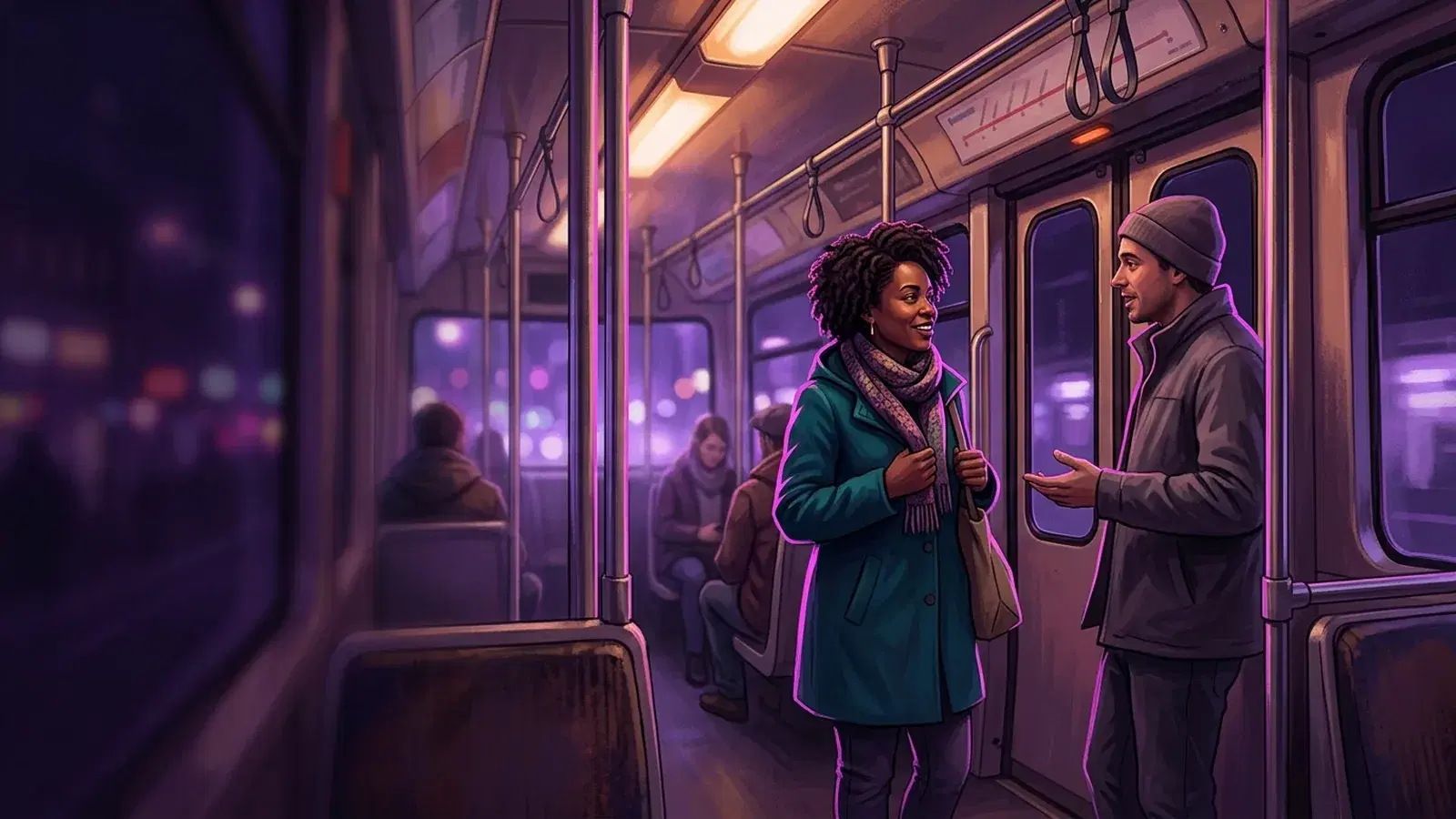
To start a conversation with a stranger, first check whether they're open to it, then open with a light comment about the moment you share, not a line. Keep it short, follow their lead, and leave while it's still good, with a clear ask or a friendly goodbye.
Key takeaways
- Read availability first: headphones in, eyes on a screen or in a hurry means not now.
- Open with the situation ("Is that one worth it?"), not with a pickup line.
- Your first line should be easy to answer and just as easy to ignore.
- Deeper conversations with strangers tend to feel less awkward than people expect (Kardas et al., 2022).
- Exit gracefully: leave on a high note, ask plainly or say a warm goodbye.
Why it feels harder than it is
Talking to someone you don't know feels risky because your brain imagines the worst-case response. The research suggests reality is usually kinder. In twelve experiments with more than 1,800 people, Kardas, Kumar and Epley (2022) found that deeper conversations with strangers felt less awkward and created more connection than people predicted. And research on the "liking gap" (Boothby et al., 2018) shows that after a conversation, people tend to underestimate how much the other person liked them.
That doesn't mean everyone wants to talk. It means that when someone is open, it often goes better than you fear.
First: are they open to it?
Respect starts before your first word. Someone's body language tells you whether you'd be a nice surprise or an interruption.
Probably open:
- Relaxed, not rushing anywhere.
- Headphones out or around the neck.
- Looking around, making brief eye contact, smiling back.
- Alone and waiting: in a queue, at the bar, between climbing attempts.
Not now:
- Headphones in, eyes on a phone, laptop or book in a focused way.
- Walking fast, clearly on the way somewhere.
- Deep in conversation with friends.
- Body turned away, arms crossed, avoiding eye contact.
If you're unsure, a small comment works as a test. If they answer warmly and add something, keep going. If they give a polite one-word answer, smile and leave them be.
Open with the moment
Pickup lines are rated worst by pretty much everyone; research on opening lines going back to the 1980s found canned, cute lines were the least attractive kind for both women and men. What works is a light comment about something you're both experiencing. It feels natural, it's easy to answer and it's easy to ignore, which is exactly what makes it respectful.
Café:
Sorry, is that the cardamom bun? I've been staring at them for five minutes trying to decide.
Bookstore:
Is that one worth it? I keep picking it up and putting it back.
Climbing or bouldering gym:
Okay, how did you do that last move? I've been stuck on it all week.
Party:
I came to the kitchen for a glass of water and I've now been here twenty minutes. How about you?
Supermarket queue:
One lemon. I respect a person with a plan.
Avoid:
Hey gorgeous, what's your name?
Do you come here often?
Comments on someone's body or looks put them on the spot, especially in public. Compliment a choice (the book, the climbing technique, the very specific coffee order), not a person's appearance.
Keep it going, briefly
Once they reply, the same rules apply as in any good conversation: follow up on what they actually said, share a little about yourself, and hand it back. If they say "this author is brilliant, the first book is even better", ask what they loved about the first one, don't switch to "so what do you do?". More on this in follow-up questions.
Keep watching the signals. Questions back, longer answers, laughter and turning towards you mean keep going. Short answers, glancing at the door or "I should get back to my friends" mean wrap it up kindly. See how to read signs someone is interested.
Special case: public transport
The U-Bahn, tram or S-Bahn is where extra care matters most, whether you're in Vienna, Berlin, Zurich or Hamburg. People can't easily walk away from a moving train, so the bar for starting a conversation is higher.
- Only start if there's an obvious opening: eye contact, a shared moment (the train stopped in a tunnel, a dog with a ridiculous coat).
- Keep it to one light comment and let them decide whether to continue.
- Headphones in means no.
- If it goes well and your stop is coming, that's a natural, low-pressure moment to ask:
This is my stop, annoyingly. I'd love to finish this conversation over a coffee. Can I give you my number?
Offering your number instead of asking for theirs leaves the choice with them.
Exit gracefully
Every good conversation with a stranger ends, and how you end it shapes how it's remembered.
If it's going well: leave while it's still fun, say so plainly, and ask.
I have to run, but I really enjoyed this. Could I get your number and continue it sometime?
For more on wording and timing, see how to ask someone out.
If they're not into it: one friendly line, then go.
Enjoy the book!
Good luck with the route.
No lingering, no second attempt, no "come on, just five minutes". Respecting a no the first time is the line that never moves, and it's also what makes people feel safe around you.
Practise it
Several Banterfox challenges are set offline, so you can try openers and exits before you try them for real: a bookstore on a rainy afternoon (Day 1), a coffee shop with a stranger at the next table (Day 2), the kitchen at a house party (Day 3), a bouldering gym and a supermarket queue (Day 4), a bar where your partner is not in the mood (Day 5), three stops on the U-Bahn (Day 6), and a wedding reception (Day 7). Day 7 then ends with a real-world mission: start one real conversation with a stranger this week and tell your coach how it went.
Sources
- Kardas, Kumar & Epley (2022). Overly Shallow? Miscalibrated Expectations Create a Barrier to Deeper Conversation. Journal of Personality and Social Psychology, 122(3), 367–398.
- Boothby, Cooney, Sandstrom & Clark (2018). The Liking Gap in Conversations: Do People Like Us More Than We Think? Psychological Science, 29(11), 1742–1756.
- Kleinke, Meeker & Staneski (1986), and Cunningham (1989). Reactions to Heterosexual Opening Gambits. Personality and Social Psychology Bulletin. https://journals.sagepub.com/doi/10.1177/0146167289151003
Frequently asked questions
How do I know if a stranger is open to talking?
Look for availability: they're not in a hurry, their headphones are out, they look around or make eye contact, and they answer your first comment with more than one word. Headphones in, eyes on a screen or short answers mean leave them be.
What is a good first line to talk to a stranger?
A light comment about the shared moment, not a pickup line. For example, in a bookstore: 'Is that one worth it? I keep picking it up and putting it back.' It's easy to answer and easy to ignore.
How do I end a conversation with a stranger gracefully?
Leave while it's still good, say you enjoyed it, and either ask for their number plainly or just say goodbye. If they seem unwilling, close with one friendly line like 'Enjoy the book' and go.
Is it okay to talk to strangers on public transport?
Sometimes, but be extra careful: people can't easily walk away on a train. Keep it to one light comment, respect headphones and short answers, and let them end it.